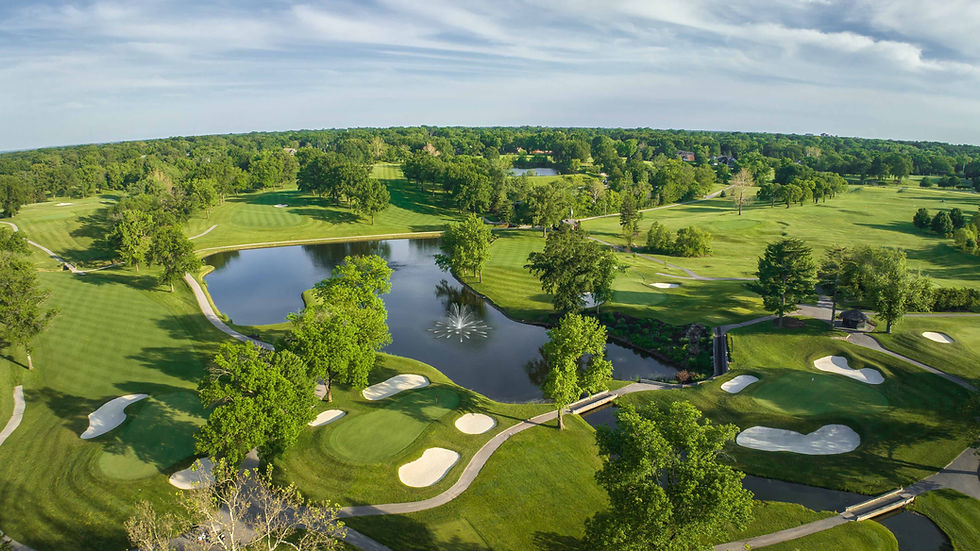
2025 Waste Management Phoenix Open Course Preview
- Andrew Lack

- Feb 3, 2025
- 11 min read
The PGA Tour heads to Phoenix this week for the Waste Management Phoenix Open, one of the only events on the schedule with a distinct personality. Consistently the highest attended and rowdiest tournament of the season, the “Waste” (as we like to call it) is pure, unadulterated fun—although it seemingly rubbed right against the fine line between fun and shitshow last year. Yet this isn’t simply one of my favorite weeks from an energy and viewing standpoint, TPC Scottsdale has completely cracked the code in terms of what we should be looking for in PGA Tour golf courses. It doesn’t beat players up enough to discourage them from coming, nor is it a banal putting contest where tee-to-green skill is mitigated. It is a golf course that allows players of all shapes and styles and skill-sets to compete. Elite distance is not a pre-requisite, and neither is elite putting skill. Players can go incredibly low on this track and make birdies in bunches, and trouble still lurks at every turn. While Waste lost their signature status last year, we will still be treated to a strong field, featuring the likes of Scottie Scheffler, Justin Thomas, Hideki Matsuyama, Sahith Theegala, Tom Kim, Sam Burns, and Sungjae Im, among others.

Former Winners
2024: Nick Taylor (-21) over Charley Hoffman (-21) (Playoff)
Winner Odds: Taylor (170/1)
Scoring Average: -1.19
2023: Scottie Scheffler (-19) over Nick Taylor (-17)
Winner Odds: Scheffler (13/1)
Scoring Average: -0.28
2022: Scottie Scheffler (-16) over Patrick Cantlay (-16) (Playoff)
Winner Odds: Scheffler (25/1)
Scoring Average: -0.77
2021: Brooks Koepka (-19) over K.H. Lee, Xander Schauffele (-18)
Winner Odds: Koepka (45/1)
Scoring Average: -1.69
2020: Webb Simpson (-17) over Tony Finau (-17) (Playoff)
Winner Odds: Simpson (13/1)
Scoring Average: -0.78
The Basics
Course: TPC Scottsdale Stadium Course
Location: Scottsdale, Arizona
Designer: Jay Morrish & Tom Weiskopf (1986), Weiskopf re-design in 2014
Par/Length: Par 71; 7,261 yards
Hazards: Water comes into play on six holes
Fairways: Bermuda-grass with perennial rye-grass and fine fescue
Rough: Bermuda-grass with perennial rye-grass and fine fescue
Greens: TifEagle Bermuda-grass with Poa Trivialis/Perennial rye-grass measuring 7,069 square feet on average
Golf Course
As previously alluded to, TPC Scottsdale rules. While I’m generally not a fan of TPC-style architecture (a little gimmicky for my taste), TPC Scottsdale outlines the ideal template for a PGA Tour course. It’s not about homogenous execution, there are some legitimate shot values and decisions that players will need to make, particularly down the stretch. The 16th hole is a much better setting than an actual golf hole, and the 18th falls touch flat as well. The 17th, on the other hand, is an immensely engaging drivable par four, and it’s one of my favorite holes to watch on the entire PGA Tour.
The golf course itself always plays right around middle of the pack in scoring. Sometimes it’s a little cold, sometimes it’s a little windy, but there really isn’t a tremendous amount of scoring variance to this golf course. Last year, it was just the opening round that played cold and difficult. Over the final three rounds, the golf course was very receptive and actually easier than it normally plays. The hardest it ranked in scoring was 2023 when it ranked 15th, and the easiest was in 2021 when it ranked 30th. Looking at the weather conditions five days out, I would expect similar scoring to last year, if not a little easier. Over the last five years, the winning score has always fallen between 17 and 21 under par, and I wouldn’t be shocked to see it threaten 22 or 23 this year.
When looking at those who have played well here, a proper combination of above-average off the tee and approach skill stands out as the safest through-line. Scottie Scheffler, Hideki Matsuyama, and Brooks Koepka make up 50% of the last 10 champions. All are above-average drivers, both in distance and accuracy, and excellent middle-iron players. Considering the low degree of difficulty of the greens, elite putting skill is far from a pre-requisite. Outside of Scheffler, Matsuyama, and Koepka -- all below-average to poor putters -- Kyle Stanley has also won this event!
TPC Scottsdale is still one of the most balanced golf courses on the PGA Tour in terms of the skill set that we should be looking for. If you are elite at something, there is a path for separation for you at TPC Scottsdale. Despite this tournament being generally won by elite ball-strikers, Nick Taylor and Charley Hoffman made the playoff last year ranking first and second in strokes gained putting. They also ranked ninth and second in approach play, and for what it’s worth, Sam Burns and Scottie Scheffler finished first and second off the tee, so it’s not like driving the ball well wasn’t important either. Point being, there is a path for everyone here, and this is one of my most balanced models of the year in terms of providing equal footing to all four strokes gained categories as they relate to the Tour average.
Stats
Off the Tee
Last year, TPC Scottsdale featured an average driving distance of 293.4, 1.1 yards above Tour average, and a driving accuracy percentage of 58.5%, which is nearly exactly at Tour average, featuring average-sized fairways of 33 yards wide. It ranked 17th out of 43 courses in strokes gained off the tee difficulty, generally ranking easier than average.
TPC Scottsdale is an incredibly driver-heavy course, featuring a driver usage percentage of 85.3% compared to the Tour average of 67.3%. Do not be fooled by the fact that there are cacti; players hit driver here everywhere, and due to the fact we are at altitude, it typically ranks as one of the longest courses in average driving distance on the PGA Tour. Last year, TPC Scottsdale ranked 41st out of 43 courses in missed fairway penalty, and 40th out of 43 courses in rough penalty. There was virtually zero difference between playing from the fairway and the negligible Bermuda over-seeded rough, but it does rank 9th in fraction of missed fairways that result in a penalty stroke, so players really can’t just miss big. What's most important is avoiding the desert and water hazards. We want to identify players who can gain an advantage via their elite driving while not having to worry about them keeping it on the planet. It’s a great week to look at SG: OTT, Distance from the Edge of the Fairway, and Good Drive Percentage
Last year, there was an even split between accuracy and distance at the top of the leaderboard, with a lot of players who were plus in distance, but not necessarily any true bombers that entirely sacrificed accuracy. Hoffman, Burns, Scheffler, Spieth, Adam Scott, and Cameron Young, all ranked top-30 in both categories. Two years ago, Scottie Scheffler, Jordan Spieth, and Jon Rahm all finished top-six despite ranking below average in driving accuracy. Wyndham Clark finished top-10 ranking nearly dead last in driving accuracy percentage, but 16 of the top 20 gained to the field in driving distance. In 2022, five of the top eight lost to the field in driving accuracy, and eight of the top 20 lost in driving distance. In 2021, six of the top 16 lost in driving accuracy, and six of the top 16 lost in driving distance. Thus, TPC Scottsdale is a course that is very evenly weighted in terms of the importance of driving accuracy and driving distance. Being elite at either of those is non-essential, yet being above average in at least one is paramount.
Approach
Last year, TPC Scottsdale featured a greens-in-regulation percentage of 70.9%, 5.0% above Tour average. The golf course features large, accessible greens that are most often being attacked with middle irons. Nine par fours measure between 400 and 475 yards, and finding birdies on these holes with elite middle-iron play remains the easiest roadmap to success at TPC Scottsdale. Last year, TPC Scottsdale ranked 32nd out of 43 courses in strokes gained approach difficulty, and it generally ranks in the middle of the pack in this category, although often it plays as an easier approach course than a driving course.
Proximity
Distance | Shot Frequency | Tour Average |
Inside 100 Yards | 8.9% | 9.0% |
100-125 Yards | 8.3% | 10.3% |
125-150 Yards | 12.3% | 17.0% |
150-175 Yards | 21.8% | 22% |
175-200 Yards | 21.0% | 17.5% |
200 Yards-Plus | 27.7% | 25.9% |
With close to 50% of approach shots coming from between 150 and 200 yards, the name of the game is middle-iron play, and the best long-term approach players from 150 to 200 yards in this field are Scottie Scheffler, Victor Perez, Corey Conners, Kurt Kitayama, and Nico Echavarria.
Around the Green
Last year, TPC Scottsdale ranked 29th out of 43 courses in strokes gained around the green difficulty, and it generally ranks middle of the pack in this category. It ranked 22nd out of 43 courses in around the green difficulty from the fairway, 41st from the rough, and 27th from the bunkers. I would place a standard to moderate weight on around-the-green play at TPC Scottsdale, as it just hovers around Tour average in degree of difficulty and percentage of strokes gained breakdown for winners.
Putting
Last year, TPC Scottsdale ranked 16th out of 43 courses in strokes gained putting difficulty, and it generally ranks as the easier putting courses on Tour. This is not a golf course with incredibly undulating green complexes. It ranked 14th out of 43 courses in putting inside five feet, 11th out of 43 courses in putting from five to 15 feet, and 20th out of 45 courses is putting greater than 15 feet. It generally ranks middle of the pack in these categories.
After two weeks on Poa, we are now back to the smooth, carpet-esque surfaces of over-seeded Bermuda. Courses that feature a similar over-seed include PGA West, Innisbrook, TPC Sawgrass, Harbour Town, Memorial Park, and Quail Hollow, among others. The best players on this surface over the last three years have been Matt Kuchar, Sam Ryder, Taylor Montgomery, Ben Griffin, and Sam Burns.
I would still recommend looking at putting with the standard amount that we would at other PGA Tour courses, despite the fact the degree of difficulty on these greens is nothing like we just saw at Torrey Pines or Pebble Beach. The make percentage from four to eight feet at TPC Scottsdale is 56.7%, which is exactly Tour average, compared to a 50% make percentage at Pebble and Torrey. The greens-in-regulation percentage at TPC Scottsdale is large enough here that catching fire with the flat-stick is still a very viable roadmap to success, as top-five finishers on average have gained just as many strokes putting as they have on approach, and winners have actually gained slightly more putting.
Scoring Stats
Like all TPC courses, scoring and aggressive play is absolutely essential. They're obviously a strong correlation entering the tournament between those who rated out highly in birdie or better percentage and those who finished near the top of the leaderboard at TPC Scottsdale. It features a 70.3% going for the green percentage compared to the Tour average of 58.6%. Trouble at every turn similarly awaits, and avoiding hazards is paramount. Yet mainly, this is course defined by a player’s ability to capitalize on the plentiful scoring opportunities. The best birdie-makers in this field are Harry Hall, Max Greyserman, Michael Thorbjornsen, Luke Clanton, and Sungjae Im.
From more of an aesthetic standpoint, desert golf is also a style that some prefer more than others. It's far from a surprise that many of the players who reside in Arizona are huge fans of TPC Scottsdale and have also experienced success at tracks such as PGA West, TPC Summerlin, and the Summit Club. The best players in this field on desert courses over the last three years have been Scottie Scheffler, Justin Thomas, J.T. Poston, Sam Burns, and Sungjae Im.
From an architectural standpoint, the TPC network has designed their courses with a very specific goal in mind: to provide an exciting track for professional golfers where the winning score falls somewhere between 14 and 25 under par. Many of the par threes are over water, and all of the par fives feature a risk/reward element. Thus, low numbers should be available, but there's enough trouble where the possibility of ejection is real too. It's important to identify the players who raise their baseline on this style of risk/reward, "TPC" style architecture. The best players on TPC courses over the last three years have been Scottie Scheffler, Hideki Matsuyama, Justin Thomas, Sungjae Im, and Brian Harman.
Course History/Comp Courses
TPC Scottsdale features some of the highest correlation of course history on the entire PGA Tour, behind only Riviera, Bay Hill, and Augusta National. Andrew Novak was the only first-timer last year to finish in the top 10. In 2023, just one player in the top 20 was a debutant! Whether it has anything to do with being more comfortable in a rowdy environment or not, course history remains incredibly important at TPC Scottsdale, and the course generally rewards well rounded players of all shapes and sizes. The best players in this field at TPC Scottsdale have been Scottie Scheffler, Justin Thomas, Hideki Matsuyama, Sahith Theegala, and Webb Simpson.
Brooks has spoken before about how he loves the atmosphere here, how the fans get him going, and that there's an energy at this event that we simply do not see at other PGA Tour stops. I don't find it to be a coincidence that this is one of the only venues he has had success at outside of major championships. I also don't find it to be a coincidence that a player such as Justin Thomas, who thrives at the Ryder Cup, has also been tremendous at TPC Scottsdale. Working theory: course history may have less to do with actual course fit, and more to do with their ability to embrace this entirely singular atmosphere? If we run through the top 10 players in this field in course history, many of them similarly raised their game on other large stages such as the Ryder Cup and major championships.
There are two other regular Tom Weiskopf-designed courses on the PGA Tour: TPC Craig Ranch and Black Desert Resort. Both have some differences to Scottsdale, as TPC Craig Ranch is far more about pure putting and power, and Black Desert Resort features a much higher missed fairway penalty. Yet both feature incredibly straightforward green complexes and reward an aggressive style of play. The other golf course (particularly last year with Bermuda over-seed) that bears a striking resemblance to TPC Scottsdale is Memorial Park, host of the Houston Open, which also rewards a balanced attack of tee-to-green play and putting and has featured a great deal of similarities across leaderboards. The best players in this field at the comp courses have been Scottie Scheffler, Hideki Matsuyama, Mackenzie Hughes, Sam Burns, and Daniel Berger.
Model
Off the Tee (18%) (PGA Tour average: 18%)
L36 Strokes Gained Off the Tee (8%)
L50 Good Drive Percentage (5%)
L50 Distance from the Edge of the Fairway (5%)
Approach (25%) (PGA Tour average: 28%)
L36 Strokes Gained Approach (15%)
L75 Proximity 150-200 yards (10%)
Around the Green (10%) (PGA Tour average: 10%)
L50 Strokes Gained Around the Green (10%)
Putting (16%) (PGA Tour average: 15%)
L3 Years Strokes Gained Putting: Poa Trivialis (8%)
L50 Putting 5-10 Feet (4%)
L50 Putting 10-15 Feet (4%)
Scoring Stats (15%) (PGA Tour average: 14%)
L50 Birdies or Better Gained (7%)
L3 Years TPC Courses (4%)
L3 Years Desert Golf Courses (4%)
Course History/Comp Courses (16%) (PGA Tour average: 15%)
L24 TPC Scottsdale (10%)
L36 Comp Courses: TPC Craig Ranch/Black Desert/Memorial Park (6%)
Model Top 20
Scottie Scheffler
Hideki Matsuyama
Kurt Kitayama
Maverick McNealy
Ben Griffin
Justin Thomas
Daniel Berger
Sam Burns
Doug Ghim
Matt Kuchar
Tom Kim
Sungjae Im
Billy Horschel
Andrew Novak
Tom Hoge
J.T. Poston
Andrew Putnam
Davis Thompson
Nick Taylor
Corey Conners
Player Spotlight: Kurt Kitayama
Kurt Kitayama is either winning Waste, or he’s coming in second to Scottie Scheffler, but this is about as confident I have felt about the marriage between a golfer’s recent form and course fit at a number north of 60/1 in quite some time. While the results to open 2025 have been less than stellar on the surface, I was tentatively optimistic in Kitayama’s approach play improvement even in a missed cut at Torrey Pines. Kitayama was by far the best approach player (and ball-striker in general of the Fall swing), and while there was a bit of regression to open the calendar year, the upside is there. Kitayama can gain 10 strokes on approach in any given week, and he is one of the few players in this entire field who can compete with Scheffler from tee to green. Just like Scheffler, Kitayama has feasted at TPC Scottsdale via long and powerful driving and elite middle-iron play. In two appearances at the Weiskopf design, Kitayama has finished 23rd and eighth, gaining strokes in all four major categories in both appearances. Just like Scheffler, the easy straightforward nature of TPC Scottsdale’s green is a massive benefit for a player whose only real struggle is with the flat-stick. We’ve seen Kitayama take down an even stronger field in a Signature Event at Bay Hill. Number two is coming this week.